
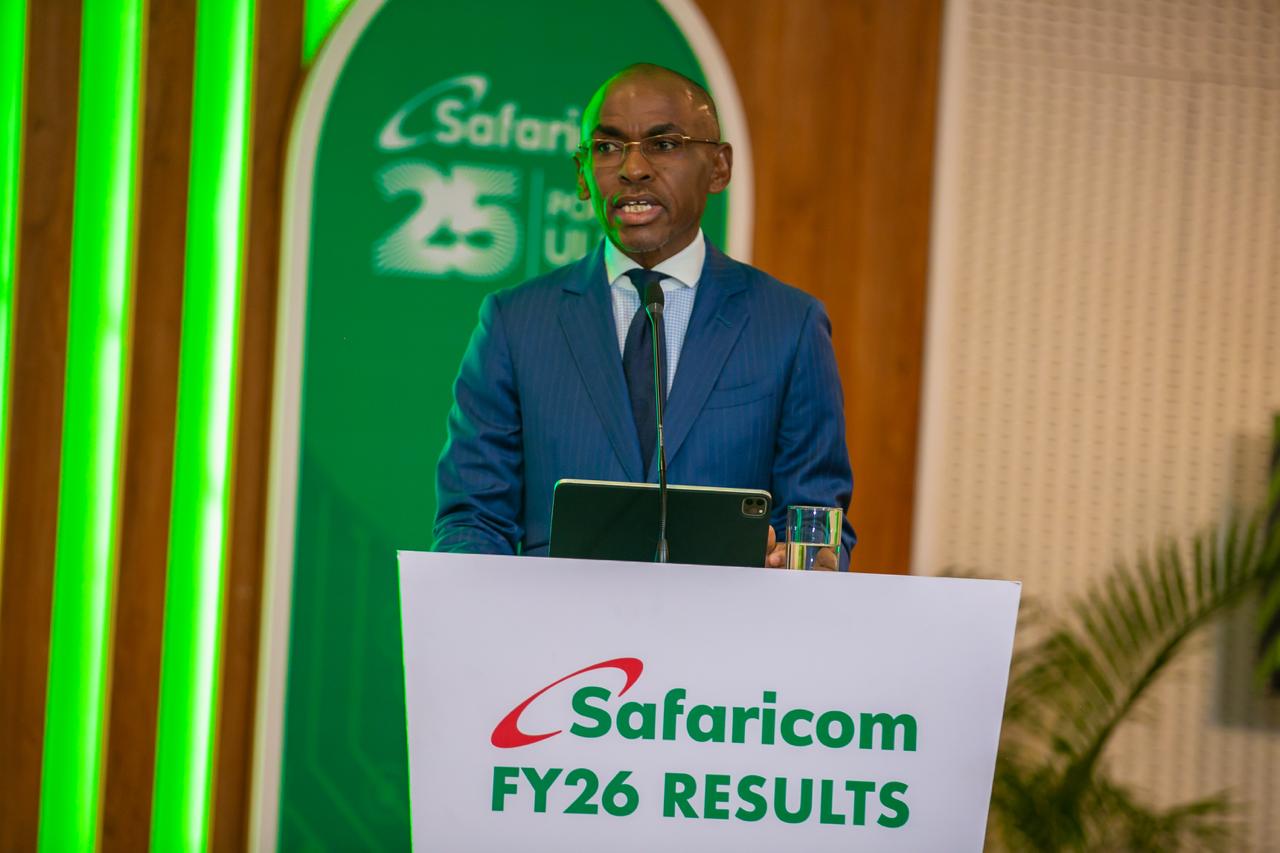
For a quarter of a century, voice calls were the engine of Safaricom's business. That era is now officially over.
Mobile data accounted for 42.1% of Safaricom's connectivity revenue in the year ended March 2026, edging past voice at 41.3%, the first time in the company's 25-year history that data has overtaken calls as its largest connectivity revenue driver. Mobile data revenue rose 14.4% to KES 83.4 billion ($646 million), while voice revenue grew just 1.3% to KES 81.8 billion ($634 million).
The shift reflects a structural change in how Kenyans communicate and consume. Average data consumption per chargeable subscriber rose 16.6% to 4.92GB per month, while the number of customers using more than 1GB monthly grew 22.4% to 14.5 million. Roughly half of Safaricom's entire mobile database now qualifies as a heavy user. Meanwhile, messaging revenue moved in the opposite direction. "Messaging revenue declined 11.8% year-on-year, driven by structural changes in customer behaviour as usage continues to migrate toward IP-based and over-the-top messaging platforms, in line with global industry trends," Safaricom said.
The device transition driving this shift is accelerating. The number of 4G+ devices on the network grew 31.8% year-on-year to 30.8 million, while 5G devices specifically surged 55.5% to 1.6 million. Feature phones declined 28.5%. Safaricom has been converting its customer base from 2G to 4G for over a decade. The FY26 results confirm that the transition is now largely complete.
Safaricom's Chief Finance Officer Dilip Pal captured the momentum plainly: "Mobile data continues to power the connectivity business as voice remained resilient."
The broader financials behind the milestone are equally striking. Safaricom posted a 67.3% rise in net profit to KSh99.7 billion for the year ended March 31, 2026, driven by strong M-Pesa growth in Kenya and sharply reduced losses in Ethiopia, making it the first Kenyan company to cross the KSh100 billion profit mark on an adjusted basis. Total revenue rose to KSh414.1 billion, up 11.5% year-on-year, while shareholders will receive a combined dividend payout of KSh80 billion, the highest by any Nairobi Securities Exchange-listed firm, representing more than three-quarters of the company's earnings.
Safaricom's share price rose 6.8% to KSh32.1 following the results, having already gained 13.2% since the start of the year. The data milestone sets the stage for Safaricom's broader pitch that it is no longer a telecom company but a technology platform. Whether the market buys that argument fully will depend on how aggressively M-Pesa, fixed internet, and financial services can grow to match the ambition. For now, the numbers speak, and they speak in megabytes, not minutes.
Stay Informed: Visit our website for Breaking News, Intelligence, and Insight.