
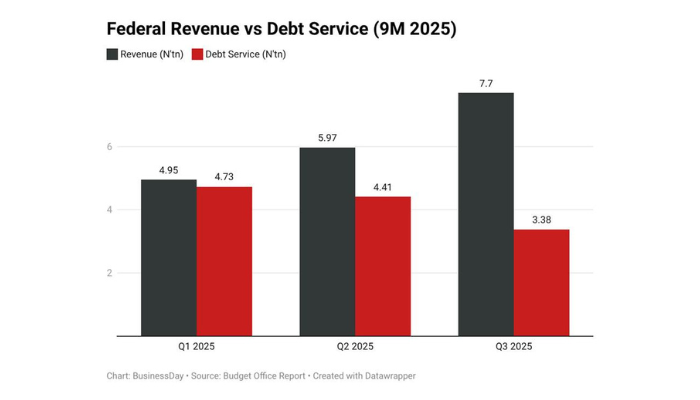
There is a number buried in Nigeria's budget implementation reports that tells the story of the country's public finances more clearly than any headline figure. It is 67.2%.
That was the share of Federal Government revenue consumed by debt service between January and September 2025, the single most damning statistic in Nigeria's fiscal story, and one that explains why a government with a ₦68 trillion budget still struggles to build roads, pay doctors, or keep the lights on.
The mechanics are straightforward and brutal. Debt service reached ₦12.52 trillion in the first nine months of 2025, exceeding the prorated budget of ₦10.45 trillion by ₦2.07 trillion. Including sinking fund contributions, total debt-related payments rose to ₦12.63 trillion. The overspending came at the same time that government revenues fell sharply short of expectations. The Federal Government projected ₦30.67 trillion in revenue during the period but generated only ₦18.63 trillion, leaving a gap of ₦12 trillion.
The trajectory into 2026 has not improved. Nigeria expects to spend about $11.6 billion servicing debt in 2026, nearly half of its projected government revenue. Debt servicing, once a manageable line item, has become the dominant claim on public resources.
The scale of the shift over the past decade is striking. Debt service has grown from ₦942 billion in 2014 to ₦4.2 trillion in 2021, reached ₦12.6 trillion in 2024, and is projected to exceed ₦15 trillion in 2026, meaning Nigeria is unlikely to escape the 50% to 60% band for debt servicing as a share of revenue in the near term.
The human cost of that trajectory is visible in the sector allocations. The 2026 budget allocates ₦15.52 trillion solely to debt servicing, a figure that dwarfs the combined allocation for education at ₦3.52 trillion and health at ₦2.48 trillion. Worse still, data from the CBN reveal that in 2025, Nigeria spent $5.21 billion servicing external debt, accounting for over 72% of total international payments, meaning that for every dollar leaving the country, 72 cents went to creditors.
The assumptions underpinning the 2026 fiscal plan are equally precarious. The 2026 budget assumes oil production of 1.84 million barrels per day at $64.85 per barrel. Historically, these production targets have proven elusive due to theft, pipeline vandalism, and underinvestment in maintenance.
Nigeria's domestic debt servicing alone jumped 46% to ₦8.6 trillion, with the borrowing plan for 2026 raised to ₦29.20 trillion, an increase of ₦11.31 trillion from the earlier projection.
The fiscal trap Nigeria finds itself in is structurally self-reinforcing: revenue falls short, so more is borrowed to cover the gap; more borrowing raises the debt service bill; a higher debt service bill leaves less for investment; less investment constrains growth; constrained growth depresses revenue. Breaking that cycle requires either a dramatic revenue surge, a sharp reduction in borrowing costs, or a debt restructuring conversation that nobody in Abuja is yet prepared to have publicly.
Stay Informed: Visit our website for Breaking News, Intelligence, and Insight