
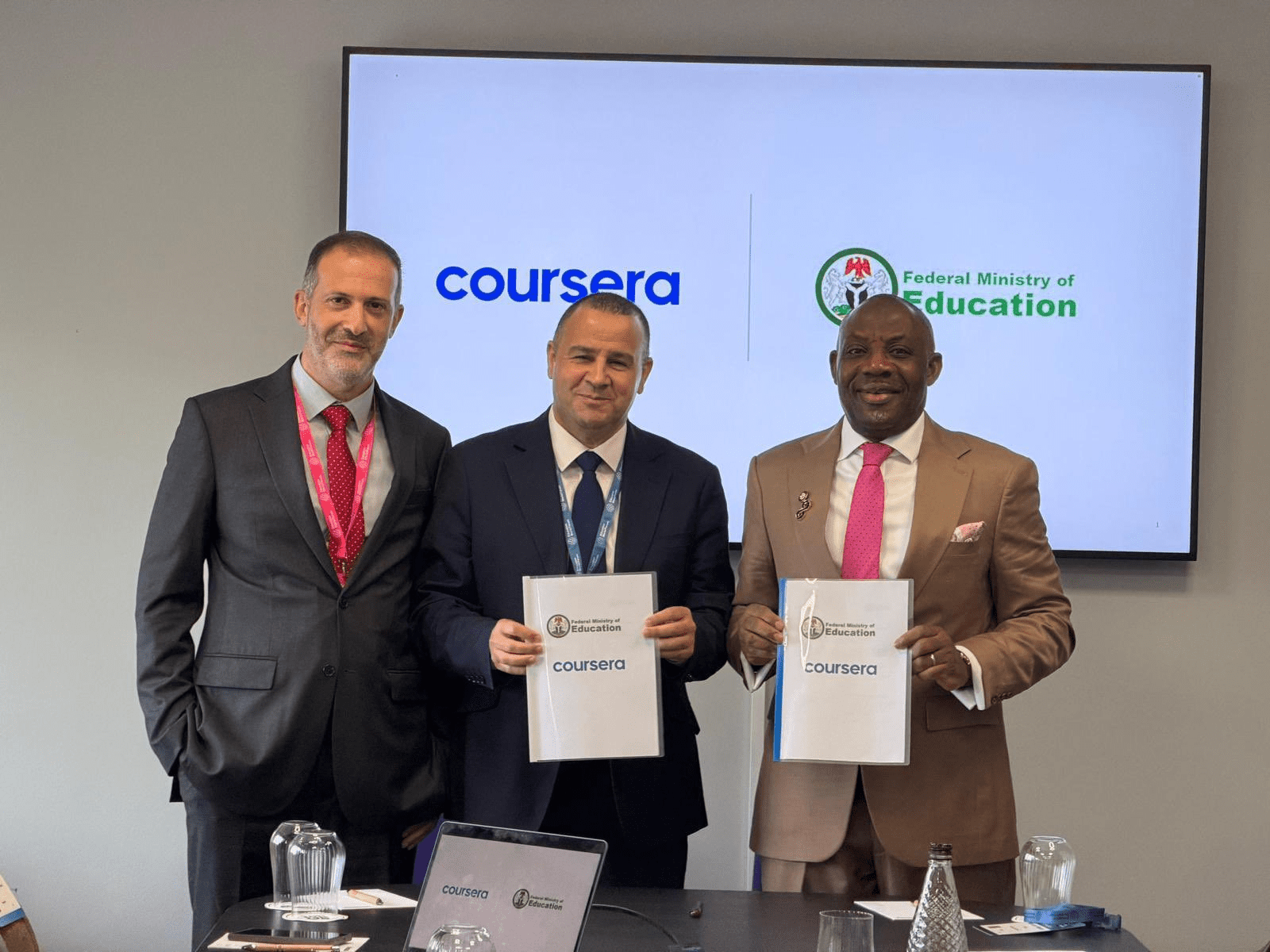
At a time when artificial intelligence is reshaping the global labour market faster than most governments can respond, Nigeria's Federal Government has made its clearest statement yet about where it intends its young workforce to stand.
The Federal Government has partnered with Coursera to provide Nigerian youths with free training in artificial intelligence, data science, cybersecurity, cloud computing, and other high-demand digital skills through the Digital Training Academy programme. The partnership was signed by Minister of Education Dr. Tunji Alausa at the Education World Forum in London.
The Federal Government has fully funded 36,000 licences across Coursera and Pluralsight for Nigerian youths in the first phase of the programme, described as one of the largest government-funded digital skills investments in Nigeria's history. Participants will bear no cost and will receive training free of charge.
Participants will earn globally recognised certifications valued by employers across the world, positioning Nigerian youths for international career opportunities. The minister described the initiative as a direct investment in helping young Nigerians compete and lead in the global digital economy: "The Renewed Hope Agenda recognises that digital competency is no longer optional. It is foundational."
The implementation architecture is designed for geographic reach. The programme will be delivered in partnership with the National Open University of Nigeria (NOUN) and Yaba College of Technology (YABATECH). NOUN's nationwide structure extends the programme's reach to all geopolitical zones, while YABATECH provides technical support, facilitators, and mentorship for participants.
Alausa pointed out the limitations of access alone: "Access to training alone is not enough. What truly changes lives is completion, support, and accountability." He described the agreement as "a covenant between government and Nigerian youth."
The Coursera partnership is part of a wider federal push on digital skills that has accelerated sharply in 2026. A separate agreement with UAE-backed Mohammed bin Rashid Al Maktoum Global Initiatives is targeting an additional 50,000 Nigerian youths through the Nigerian Youth Academy, covering AI, robotics, cybersecurity, and vocational training. Together, the two programmes alone represent commitments to train over 86,000 young Nigerians in technology disciplines within the year.
The training spans fields including AI, data science, cybersecurity, cloud computing, and software engineering, all categories where global employer demand consistently outpaces supply and where African talent remains chronically underrepresented in international hiring pipelines.
For a country with over 70% of its population under 35 and an unemployment rate that continues to strain social cohesion, equipping tens of thousands of young Nigerians with certifications that are legible to global employers is not merely an education policy. It is an economic strategy with the clock running.