
Ten years ago, Shuttlers set out to make the Lagos commute less punishing. It has just crossed 10 million trips and made its routes visible to every Google Maps user in Nigeria.
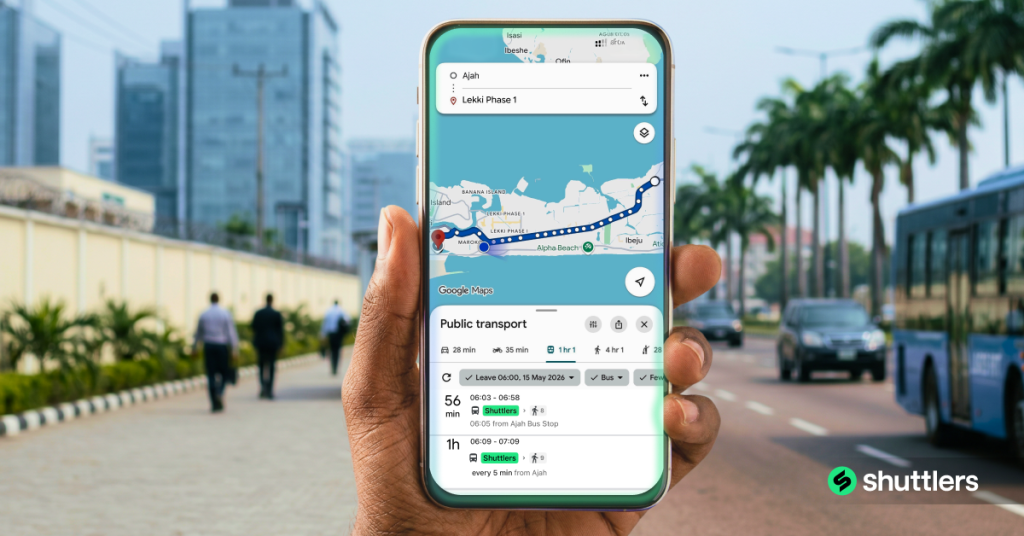
Shuttlers, the Nigerian shared mobility startup, has integrated its bus routes into Google Maps Transit, bringing its services to the navigation platform after completing more than 10 million trips since launching in 2016. The integration brings Shuttlers' scheduled routes into Google Maps' transit layer, allowing commuters to discover routes and book seats directly within Google Maps while navigating Nigeria's major cities.
The Google partnership did not come easily. To qualify as a Google Transit Partner, Shuttlers was required to align its data architecture, route systems, and real-time operational capabilities with Google's partner infrastructure requirements, a technical certification that positions the company alongside formal transit operators globally and makes its routes legible to millions of Nigerians who open Google Maps every day to plan their journeys.
Shuttlers currently serves 30,000 active users across more than 1,000 itineraries, operating more than 430 buses daily across Lagos, Abuja, and Port Harcourt. Since launching in 2016, the platform has maintained a 99% trip completion rate and a 99.94% incident-free rate across its entire journey history.
CEO and Co-Founder Damilola Olokesusi was direct about what the milestones represent: "For millions of professionals, commuting is still unpredictable, exhausting, and expensive. We have spent the last 10 years building technology and operational infrastructure that makes daily transportation more dependable for commuters, businesses that employ them, and the fleet operators who power our network."
Olumide Balogun, Google's Director for West Africa, described the integration as part of a broader effort: making trusted transportation easier to discover as more Nigerians adopt digital tools for everyday tasks.
The urban context behind the milestone is stark. According to the World Bank, African cities are about 29% more expensive overall than cities at similar income levels, with residents paying roughly double the global average for transport. In Lagos, the average commuter spends about 2.21 hours in transit daily, equivalent to roughly 11 hours in a five-day workweek. African cities lose an estimated 2% to 5% of GDP annually to transport inefficiency, and the average Lagos commuter loses more than 30 hours a month to gridlock.
The next chapter is green. Beyond the Google Maps tie-up, Shuttlers is integrating Compressed Natural Gas (CNG) and electric buses into its fleet, targeting emissions reductions of up to 60% against diesel equivalents. The company currently employs over 300 drivers daily and runs a Vehicle Partner Programme that enables fleet operators to generate recurring income through the platform.
Ten million trips in ten years. Now, for the first time, any Nigerian searching for a bus route on Google Maps can find Shuttlers waiting for them.
Stay Informed: Visit our website for Breaking News, Intelligence, and Insight